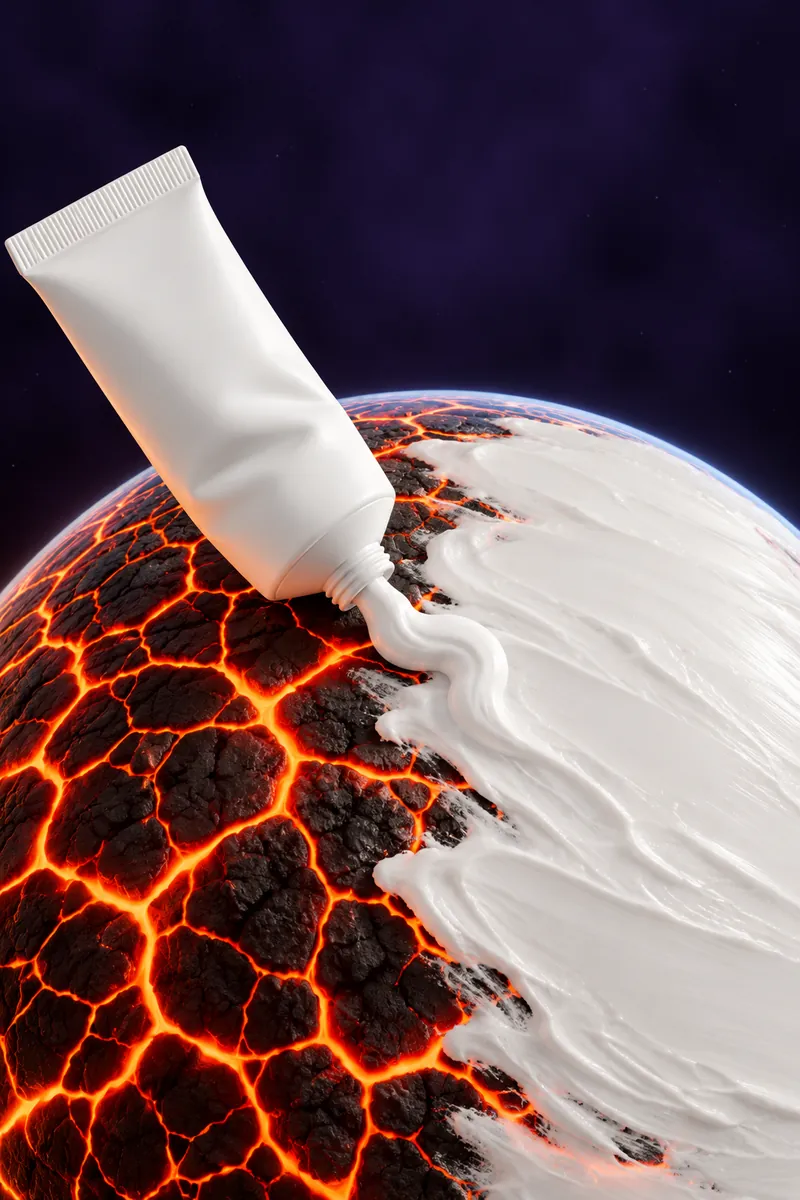
TOI-561 b shouldn't have an atmosphere. It's a rocky planet about 1.4 times as wide as Earth, some 280 light years away, and it orbits so close to its star that a year lasts under 11 hours. That's two birthdays a day, with a bit left over.
Its surface is thought to be an ocean of molten rock. Rocky planets this heavily irradiated are expected to have lost their air billions of years ago. New measurements from the James Webb Space Telescope suggest that this one hasn't.
How close is close?
The planet sits about 1.6 million kilometres from its star, roughly one-fortieth of the distance between Mercury and the Sun. It's also tidally locked, so one side is always in daylight and the other is always in darkness.
NASA says the star spans a quarter of the planet's sky. We ran the published figures to get a sense of what that looks like, and the star comes out at about 44 degrees across, some 80 times wider than the Sun looks from Earth. Hold a beach ball at arm's length and you have a rough idea. That comparison is our own sum, not something from the study.
What Webb saw
For 37 hours, Webb watched the planet make nearly four trips around its star, tracking how its brightness and heat changed along the way. Astronomers call this a phase curve. Three results didn't fit a bare ball of lava.
- The day side is too cool. NASA puts a bare rock here at around 2,700°C. The new study measures about 1,775°C.
- The heat isn't on the night side either. At about 815°C, that side isn't warm enough to account for the difference.
- It's very bright. The planet reflects roughly three-quarters of the starlight that hits it, which is comparable to Venus. Lava surfaces, by contrast, are dark: a 2020 study puts them at about 10% at most.
So a dark surface is behaving like a bright one, and heat seems to be moving around the planet. Together, those point to an atmosphere, probably a thick one. The paper's estimate is 1 to 10 times Earth's surface pressure.
The sunscreen
The "sunscreen" comes from the University of Birmingham's press release, and it's a comparison, not a discovery of anything creamy. The idea is that rock vapour rising from the magma ocean condenses into clouds of silicate minerals, including silicon dioxide and magnesium silicate. Silicon dioxide is the main ingredient of quartz and most beach sand.
Those clouds would bounce starlight away before it reaches the surface. In the researchers' climate simulations, they can explain how bright the planet is. By keeping the planet cooler, they may also help it hold on to an atmosphere that would otherwise be stripped away.
Note the "may". This is the explanation that fits best so far, but nobody has photographed a cloud on a planet 280 light years away.
What nobody knows
The list is long, and it's the best part of the story.
- What the air is made of. It could contain a lot of carbon dioxide, like a much hotter Venus, or a lot of sulphur dioxide, like Jupiter's moon Io.
- How the planet keeps it. One possibility is that the magma ocean keeps topping it up.
- Whether the clouds are really the answer. They match the models. Direct confirmation would take more observations.
A note on what we read
The study is in The Astronomical Journal, and we read the preprint, the version authors share publicly beforehand, so small details may differ. We also compared its numbers with those from NASA, whose figures come from an earlier study by the same team. That's why you may see slightly different day-side temperatures quoted, such as 1,800°C.
What we read
- Boucher and others, A Highly Reflective Atmosphere on the Lava World TOI-561 b, preprint, 2026
- University of Birmingham, Shiny lava planet challenges astronomers' expectations, 2026
- University of Waterloo, Clouds on a lava planet challenge what astronomers expected, 2026
- NASA, Webb Detects Thick Atmosphere Around Broiling Lava World, 2025
- NASA, TOI-561 b in the exoplanet catalogue
- Essack, Seager & Pajusalu, Low-albedo Surfaces of Lava Worlds, 2020