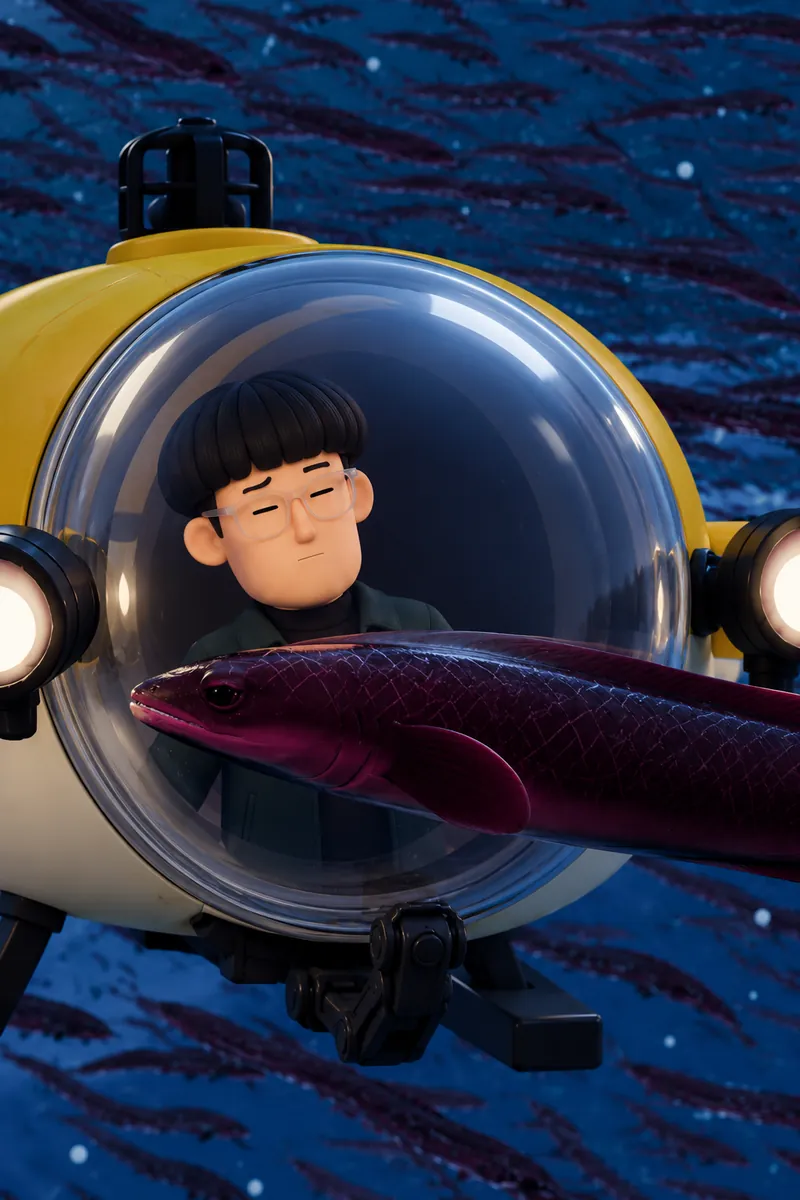
About a kilometre down, off the south of Tasmania, there's an underwater mountain with a footprint of perhaps two or three square kilometres. It has a good name, Patience Seamount, and for a few months a year it's home to one of the strangest gatherings in the ocean.
What they found
Australia's national science agency, CSIRO, surveyed the seamount with sonar from 2023 to 2025, using towed cameras to work out which species was which and catching a few animals. The results appeared in Royal Society Open Science in October 2026.
From March to May, the southern autumn, the biomass of basketwork eels (Diastobranchus capensis) rises from about 750 tonnes to more than 3,500 tonnes, or about 2.8 million animals. At its largest, the swarm is around 3 kilometres long, 2 wide, and stands 150 metres above the seabed.
Those eels can grow to 1.8 metres, and they get their name from tiny, elongated scales set into the skin, which look like woven basketwork. They're dark brown to purplish-black, and live at 792 to 1,786 metres, where no sunlight reaches.
Making sense of the numbers
Figures this large are hard to picture, so we did some sums.
- Counting. At one eel per second without stopping, 2.8 million would take 32.4 days.
- Weight. 3,550 tonnes is hard to convert exactly, since cars vary. With a small car at 1.3 tonnes, that's about 2,700 cars. With an average new car at 1.95 tonnes, about 1,800. "About 2,000 cars" sits in the middle, and it's honest as long as the "about" stays.
- Each eel. Divide the weight by the number and you get about 1.27 kilograms on average. That's our own back-of-the-envelope figure, not the study's.
Why are they there?
Almost certainly to spawn. Patience Seamount is described as the only known spawning aggregation of deep-sea eels in the world. The eels the researchers caught, male and female, were in an advanced state of readiness to spawn, and the females carried advanced eggs. Their bellies were empty, too.
That leads to a nice piece of detective work. The team managed to catch only seven, which is remarkable given the numbers. Their proposed explanation is that the eels may stop eating as they prepare to spawn, and an eel that isn't hungry won't take the bait. That's still an inference.
The eels also share the mountain without much overlap: they gather on the deeper, flatter ground at the base, while orange roughy, another fish that aggregates here, use the steep slopes higher up.
What nobody knows
The Huon and Tasman Fracture marine parks hold around 120 seamounts. Many are similar, and they're close together. Why this one? Lead researcher Ben Scoulding calls that one of the biggest unanswered questions. One possibility the authors raise is that the seamount sits close to the continental shelf, but that's a guess.
They also haven't yet established exactly when and where spawning takes place, so even the main event is still to be pinned down.
A note on what we read
We should be upfront: we read the study's abstract and a detailed interview with the lead author, but the journal's site wouldn't serve us the full text. Anything not in the abstract comes from the other sources listed below, and if you have the paper and find we've got something wrong, please tell us.
What we read
- Scoulding and others, A unique ecological phenomenon quantified by hydroacoustics, Royal Society Open Science, 2026
- ScienceAlert, Millions of mysterious deep-sea eels caught gathering off the coast of Tasmania, 2026
- eAtlas / NESP Marine Hub, Mountains of deep-sea discoveries
- NESP Marine Hub, Reely deep: fishing a unique gathering of eels, 2018
- Australian Museum, An orgy of eels
- Fishes of Australia, Basketwork Eel