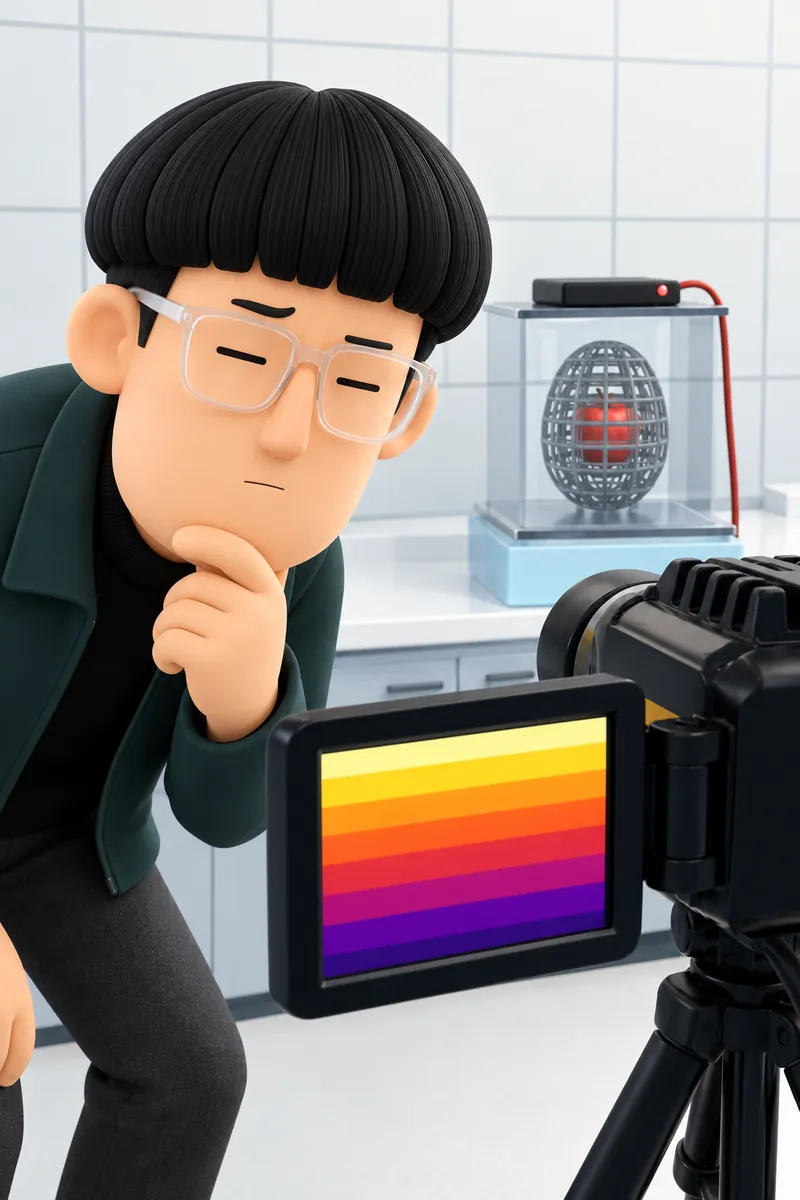
A thermal camera doesn't really see objects. It sees heat, and heat has to get from the warm side of a room to the cold side somehow. Put something in the way that conducts heat better or worse than its surroundings, and the flow bends around it. That bend is what gives the object away, even when it's the same temperature as everything else.
So to hide from a thermal camera, you don't need to block the heat. You need to steer it around the object and then put it back exactly where it would have been. That is what a team from the University of Illinois Urbana-Champaign and the Technical University of Denmark did, in a study published in Nature Communications in 2026.
How it's built
The theory is called transformation thermotics, and it tells you how well each point in space would have to conduct heat for the flow to pass around a hole without noticing. The hard part is making that material. The researchers used a lattice:
- a 3D-printed aluminium cage, with bars at least half a millimetre thick
- a silicone rubber poured into the gaps, which conducts heat far worse than the metal
- all of it set inside a block of conductive material
Vary how dense the cage is from place to place and you vary how well each spot carries heat. Earlier cloaks mostly worked in two dimensions, or with heat coming from just one direction. This one was tested with heat running both top to bottom and side to side.
The apple inside the pear
The test object is the part we couldn't resist. The team hid an apple-shaped rubber core inside a pear-shaped cloak, and placed the block between a plate heated to 40°C and a tank of iced water. An hour later, once the temperatures had settled, they filmed it with an infrared camera.
Outside the cloak, the bands of equal temperature stayed straight and evenly spaced, as if nothing were there. Without a cloak, those same bands visibly curve towards the hidden core. Inside, almost no temperature difference built up, so the apple was also shielded from the hot and the cold.
They also designed a cloak in the shape of a head: a face with glasses, hidden inside two other faces. That one was checked by computer simulation and printed in plastic. The metal version measured with the camera was a different design, so the head-shaped cloak is better described as designed than as built.
What it won't do
News coverage tends to skip this list, so here it is.
- It isn't something you wear. It's a solid block of metal and rubber.
- It only works on heat. You can still see it perfectly well with your eyes.
- It can't hide anything that makes its own heat. Solving that is the next thing the researchers want to do. It rules out people, for now.
- It needs stable temperatures. The supplementary material says a steady-state cloak can't hide an object perfectly from rapidly changing thermal detection.
- It has a temperature ceiling. With these materials, about 150°C.
- It's a lab result. Suggested uses, such as managing heat in electronics, protecting equipment and security work, are proposals so far.
The date on the news
If you saw this story in late October 2026, it may have looked brand new. The study appeared online on 20 May, the university announced it on 13 July, and ScienceDaily ran it in October. That's normal for science news, and a good reason to be wary of "this week" in a headline.
What the real thing looks like
Forget the translucent block in the illustration at the top of this page. The real one is opaque grey, and the team made half a block so that the camera could look at the cut face. The apple isn't red either: the core is silicone rubber.