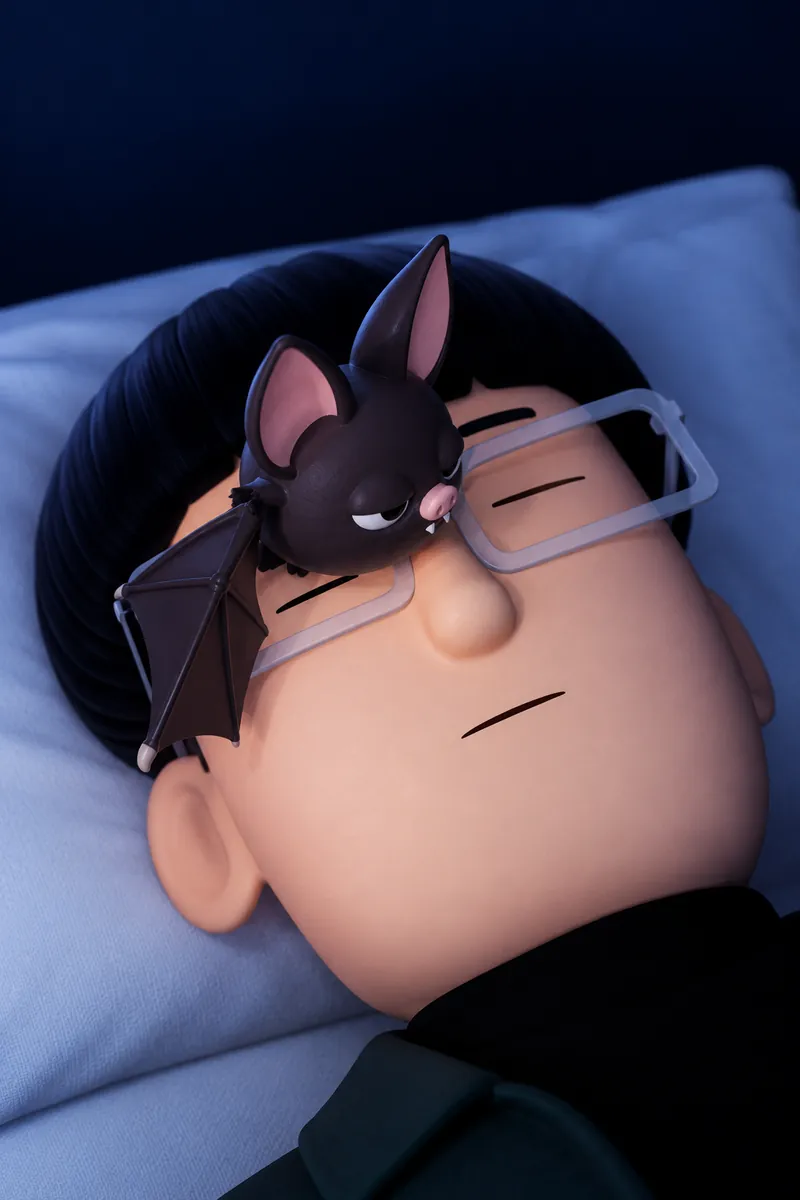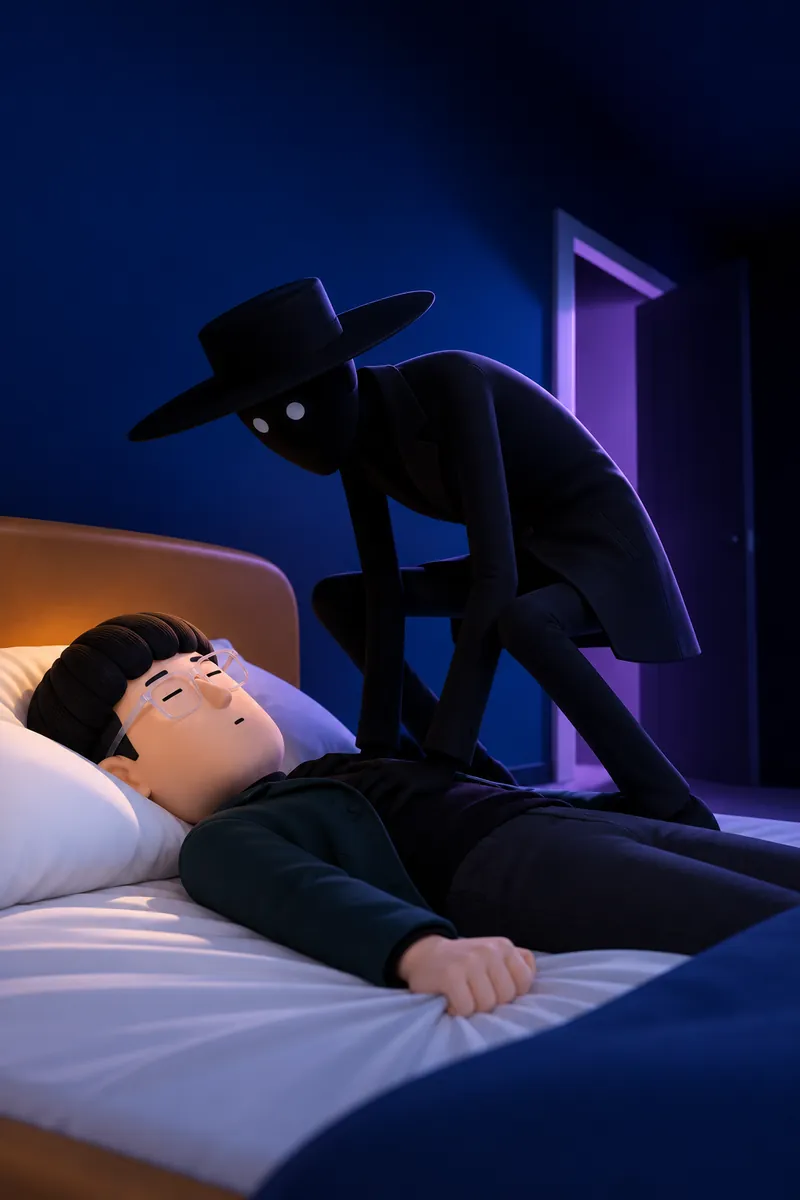
It is three in the morning. Your eyes are open and you can see your bedroom: the door, the chair, the shape of the wardrobe. You try to sit up and nothing happens. You try to shout and nothing comes out. Then you notice somebody standing in the doorway.
There is nobody in the doorway. But for anything from a few seconds to a few minutes, every part of you that decides what is real will insist otherwise.
What is actually happening
When you dream, your brain switches off most of your muscles. Doctors call this atonia, and it is the reason you don't act out your dreams and sprint into a wall. Normally the switch flips back before you are aware of anything.
In sleep paralysis the timing slips. You regain awareness on the way into or out of REM sleep, while the paralysis is still on. Dream imagery can come along for the ride, and that is what makes the experience so convincing: your eyes really are looking at your real room, and the dream is playing on top of it.
Your eyes and your breathing keep working throughout, which is why people remember looking around the room without being able to lift a finger.
Three kinds of visitor
In 1999 the psychologist J. Allan Cheyne and his colleagues sorted the hallucinations into three groups:
- The intruder. A sense of presence and fear, often with seeing or hearing someone.
- The incubus. Pressure on the chest, trouble breathing, sometimes pain.
- Strange body sensations. Floating, or the feeling of leaving your own body.
These are old companions. Newfoundland has the Old Hag, Japan has kanashibari, and in Mexico people say se me subió el muerto, "the dead man climbed on me". In one Mexican survey, 92.5% of the teenagers asked knew the phrase. Look at Henry Fuseli's 1781 painting The Nightmare, with a creature squatting on a sleeper's chest, and the second group is hard to miss.
How common is it?
The most useful figures come from a 2011 review by Brian Sharpless and Jacques Barber, covering 35 studies and 36,533 people. At least one episode in a lifetime was reported by:
- 7.6% of the general population
- 28.3% of students
- 31.9% of psychiatric patients
You'll often see "more than one in four" quoted. That's accurate for students, but it isn't the same as one in four people. The number for everybody is closer to one in thirteen. Frequency varies just as widely: for some people it happens once in a lifetime, for others every night.
What makes it more likely
Three things turn up repeatedly in the research and in NHS guidance: too little or badly disrupted sleep, including shift work and jet lag; stress; and sleeping flat on your back. The NHS suggests seven to nine hours at regular times, and avoiding sleeping on your back.
Which makes the obvious plan, staying awake all night so that it can't happen again, the worst one available.
When it's worth seeing a doctor
The NHS describes sleep paralysis as scary but harmless, and most people need no treatment at all. It is worth mentioning to a doctor if it happens often, if it leaves you afraid to go to sleep, or if you are constantly tired.
What we couldn't confirm
The internet is full of tricks for breaking an episode, such as concentrating on moving one toe. They weren't in any of the sources below. That doesn't mean they fail. It means we couldn't back them up, so we aren't recommending them.
What we read
- Sharpless & Barber, Lifetime prevalence rates of sleep paralysis, Sleep Medicine Reviews, 2011
- Penn State, Psychologists chase down sleep demons, 2011
- NHS, Sleep paralysis
- Bhalerao and others, Recent Insights Into Sleep Paralysis, Cureus, 2024
- Cleveland Clinic, Sleep Paralysis
- Cheyne, Rueffer & Newby-Clark, Hypnagogic and hypnopompic hallucinations during sleep paralysis, Consciousness and Cognition, 1999
- Cheyne, Situational factors affecting sleep paralysis, Journal of Sleep Research, 2002