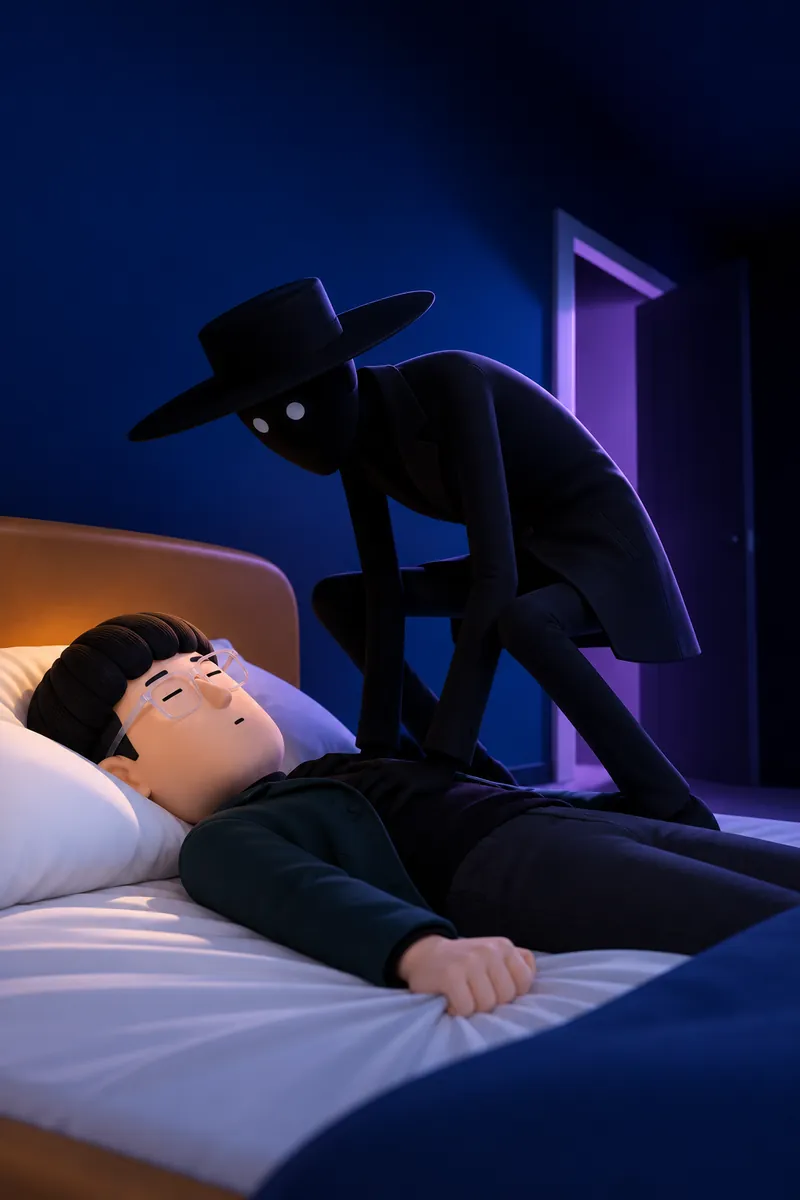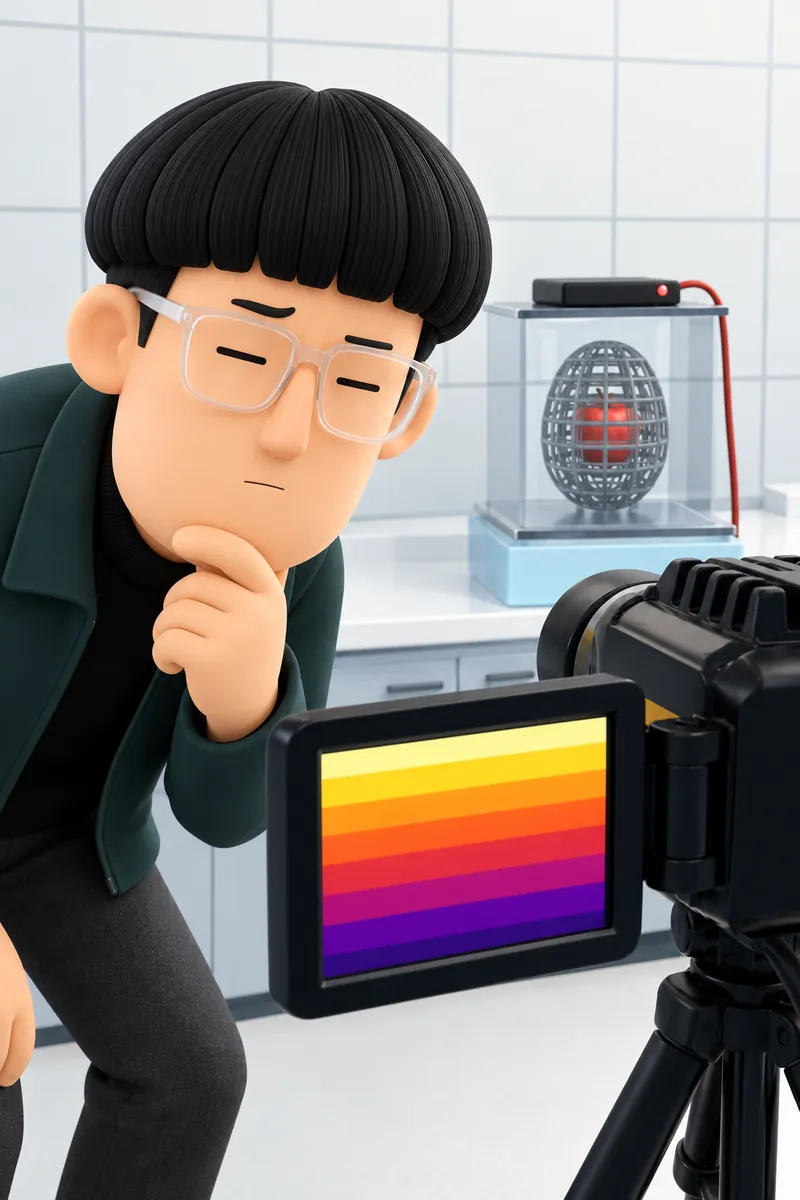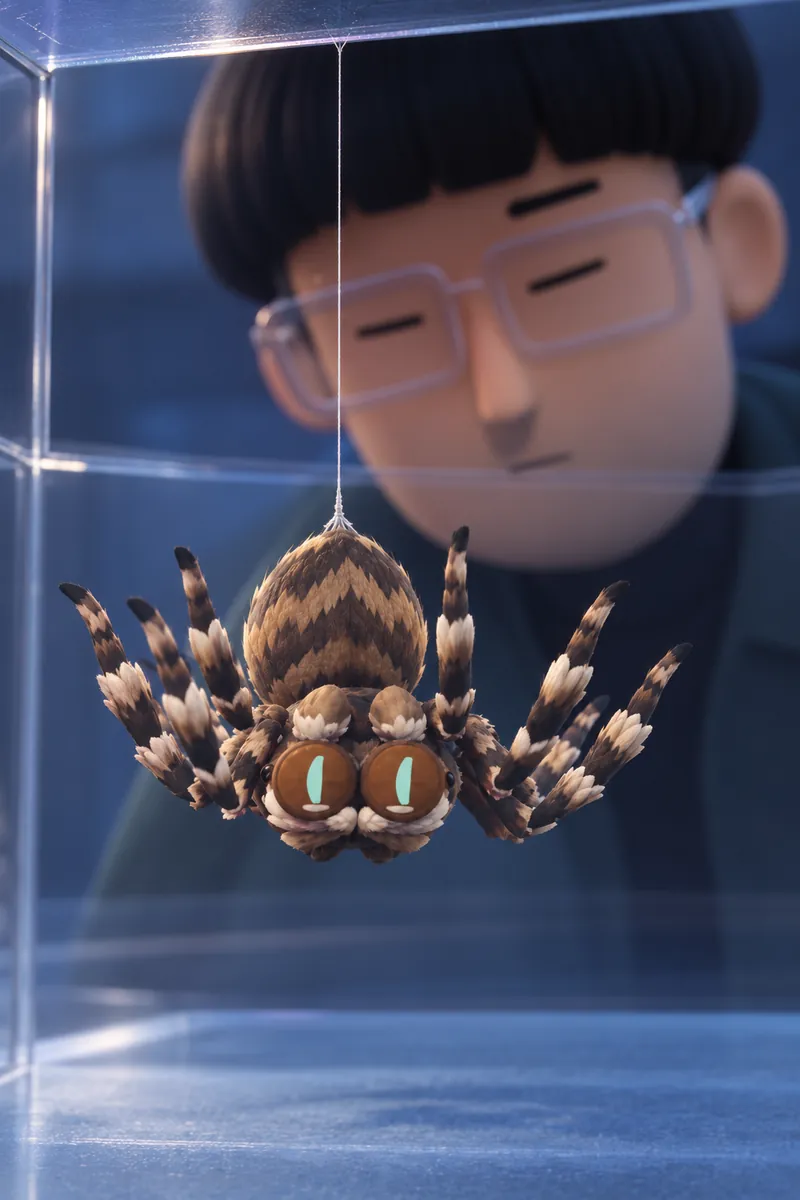
At dusk, Portia fimbriata, a jumping spider from Queensland in Australia, picks a spot, grooms itself and settles upside down beneath a small platform of silk. It falls asleep around 14 minutes after the lights go out. About four hours later, something odd starts: its retinas dart about, and its legs twitch and curl.
A team led from the University of Bonn set out to test whether that's real sleep, and what kind. Their results appeared in PNAS in October 2026.
What the REM-like phase looks like
The researchers followed ten spiders through the night and logged 109 episodes. On average, a spider slept for 10.7 hours and had about 11 episodes, each lasting about 83 seconds. During an episode:
- The retinas move rapidly. In a jumping spider the lens stays put, and what moves is the retina at the back of a tube-shaped eye. It's a different design from ours that produces a similar-looking result.
- The body twitches. Legs, abdomen, spinnerets, mouthparts and the small limbs called pedipalps can all jerk.
- The legs curl. This happened in 38.8% of episodes.
The curling has a neat possible explanation. Spiders extend their legs using fluid pressure, so a leg that curls may mean that muscle tone and pressure have dropped. The authors say this is reminiscent of the muscle paralysis in REM sleep in vertebrates, including us. That's their interpretation, and they present it as a probable one.
Test one: is it harder to wake?
Real sleep should make you less responsive, so the team played a 400 Hz tone that grew louder over ten seconds, through a small speaker under the platform.
- Awake: spiders reacted in 1.69 seconds on average.
- Asleep and still: 2.71 seconds.
- In the REM-like phase: 4.27 seconds, more than twice as long as when awake.
Every spider reacted when awake or still. In the REM-like phase, only six of the ten did. The other four didn't react within the ten seconds, although they reacted right away when tested awake.
Test two: the fruit fly night
This is the part we like most. To disturb a spider's sleep without touching it, the researchers put 25 live fruit flies in its small box when the lights went out, and left them there for the 12-hour night. The spiders didn't eat the flies. They just kept being woken by them, shifting around, flinching and trying to brush them off, and they had no REM-like episodes.
The following night, 13 spiders showed what happens next:
- REM-like time rose from 9.4 to 16.9 minutes, nearly 80% more.
- Episodes rose from 6.1 to 10 a night.
- Each episode lasted about the same, so they caught up with more episodes and not longer ones.
Five control spiders, spared the flies, showed no such increase. Anyone who has slept badly and then gone out like a light the next evening will recognise the idea, although the paper calls this sleep disruption and not full deprivation, as the spiders may have managed some sleep between flies.
Do spiders dream?
Nobody knows, and we should be blunt about it. The researchers didn't measure brain activity, so everything here is based on behaviour. The paper doesn't discuss dreams at all, even if some headlines do.
What the authors suggest is more cautious: this state may support learning, sensory recalibration or making sense of experience, as it's thought to in mammals. They link this to how Portia lives. It has remarkable eyesight, and it specialises in hunting other spiders with planned approaches, which may give it a lot to process.
Claims we're not repeating
- "Spiders have REM sleep." This is one species, plus a related finding from 2022 in another jumping spider. And "REM-like" is the honest wording.
- "The first time in an invertebrate." Some coverage says this about the rebound. We couldn't find that wording in the paper, which calls its findings the strongest evidence to date for a REM-like state in a terrestrial invertebrate. Fruit flies were already known to catch up on sleep, though not this kind.
What we read
- Geiger and others, Behavioral evidence for two-stage sleep in spiders, PNAS, 2026
- Rößler and others, on REM-like behaviour in another jumping spider, PNAS, 2022
- University of Bonn via EurekAlert, press release, 2026
- ABC News Australia, on the study, 2026
- ScienceAlert, on the study, 2026
- BBC Science Focus, on the 2022 study and how the spiders' eyes work