Ad Links marked (Ad) are affiliate links. As an Amazon Associate I earn from qualifying purchases.
Products here are on topic, but we haven't tested them. Drawings are ours, not photos of the exact product.
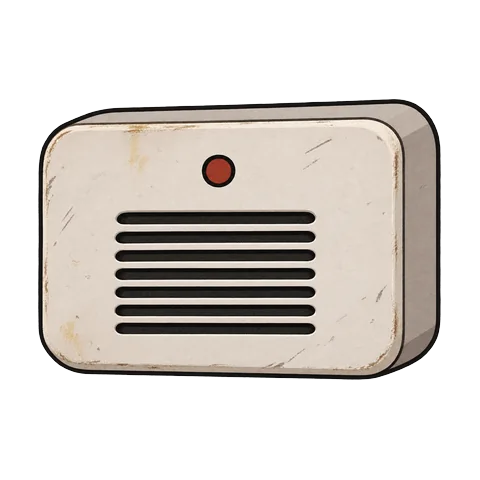
Carbon monoxide alarm
(Ad) See on Amazon
Carbon monoxide (CO) has no colour, smell or taste, and the Fire Kills campaign says an alarm is the only way to detect it.
The NHS advises an alarm for each room with an appliance burning gas, oil, coal or wood. Which? adds that CO can seep through walls, so in a semi or terrace with a fuel-burning neighbour, the safety-first approach is to fit one even in an all-electric home. Every Scottish home with a carbon-fuelled appliance other than a gas cooker or hob must have one; elsewhere legal duties mostly fall on landlords and new installations.
The standard
London Fire Brigade says to buy only alarms certified to EN 50291 and carrying an approval mark such as the Kitemark. Scottish Fire and Rescue Service asks for the Kitemark and EN 50291-1, the version Which? uses for its checks. Caravans and houseboats need BS EN 50291-2.
The number alone is no guarantee. Which? says every unbranded alarm it has tested failed to detect the gas. In 2022 the Office for Product Safety and Standards reported an unbranded marketplace alarm as a serious risk because it did not sufficiently detect CO at levels the standard requires. So choose a brand you recognise and check who is selling it, whichever site you use.
Battery life and sensor life
These are separate clocks. Which? says sensors start to fail after a set lifetime, and the Welsh Government says CO alarms generally need replacing more often than smoke alarms. Sources differ: Northern Ireland's HSE says one to six years, while Which? says as long as ten. Check the stated life, and don't read a battery figure as a sensor figure.
England's building guidance for new installations asks for a battery designed to last the alarm's working life, with a warning when that life is due to pass, or fixed mains wiring, not a plug, with a sensor failure warning. England's landlord guidance prefers sealed-for-life batteries. If yours are replaceable, Which? says to change them yearly or at the low-battery signal, and to avoid rechargeables.
Where to fit it
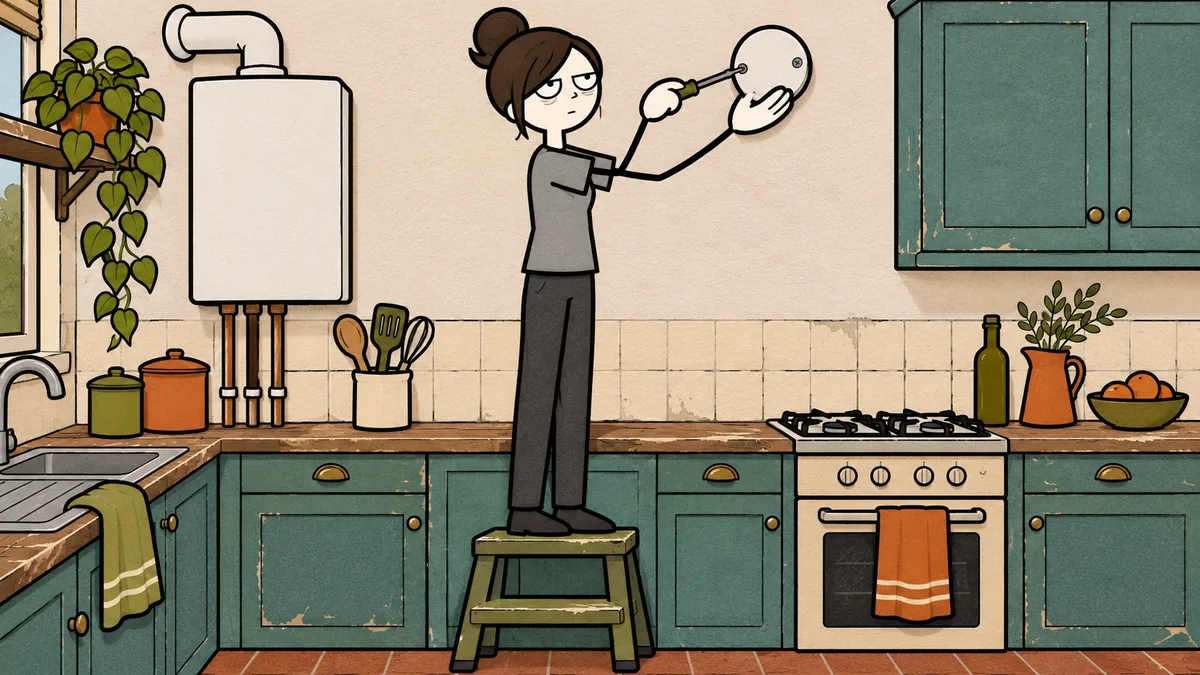
Fit it in the same room as the appliance. On height, official advice differs:
- England's building guidance: on the ceiling at least 300mm from any wall, or high on a wall, above doors and windows but not within 150mm of the ceiling, and 1m to 3m horizontally from the appliance.
- England's landlord guidance: at head height on a wall or shelf, about 1m to 3m from the source.
- Which?: high up, around 15cm from the ceiling, at least 1m from boilers, cookers and fires, and not directly above heat or steam.
- Northern Ireland's HSE: not low down. The Welsh Government: sometimes lower than smoke alarms.
So follow the manufacturer's instructions, as most of them advise. Never cover or paint over the alarm, and test it as the instructions say.
London Fire Brigade says it should be heard throughout your home and wake you, so you may want one in the bedroom.
What to avoid
- Colour-change or black spot indicators. London Fire Brigade says to buy audible or hard-of-hearing alarms instead. A card will not wake you.
- Alarms whose instructions rule out the kitchen, as Which? found in many of its Don't Buy alarms.
- Treating an alarm as a substitute for proper installation and maintenance.
What it won't do
It won't always go off straight away. In Which?'s checks, an alarm should sound between 60 and 90 minutes at 50ppm, and take 3 minutes at 300ppm. So with symptoms, don't wait for it. The NHS says to stop using the appliance if you can, go outside and get medical advice, and to call the emergency services for serious symptoms such as trouble breathing or sudden confusion. In the UK, the gas emergency line is 0800 111 999, or 0800 002 001 in Northern Ireland.
The short version
- Get an audible alarm for every room with a fuel-burning appliance, and fit it as the instructions say.
- Look for EN 50291 and an approval mark, from a brand you recognise.
- Check the stated life: sensors wear out, whatever the battery does.
- Skip indicator cards and unbranded alarms.
- With symptoms, don't wait for the alarm.
This is general information. Official instructions for your area always come first.
Free: the 3-day kit checklist
Sign up and get our printable checklist of what to keep at home for three days. Then about one short email a week with a small job to do. It takes minutes, and Harry won't do it.
Get the free checklist and about one email a week with safety tips and kit ideas. Unsubscribe any time. Privacy notice.
What we read
- Fire Kills, GOV.UK: Detection
- NHS: Carbon monoxide poisoning
- London Fire Brigade: Carbon monoxide safety
- HSENI: Carbon monoxide alarms
- HSENI: Carbon monoxide
- Scottish Fire and Rescue Service: Smoke and heat alarms
- gov.scot: Fire and smoke alarms, the law
- Which?: Carbon monoxide detectors
- Office for Product Safety and Standards: Product safety report, carbon monoxide alarm
- GOV.UK: Changes to Approved Document J (England)
- GOV.UK: Smoke and carbon monoxide alarm regulations, guidance for landlords and tenants (England)
- GOV.WALES: Fitness for human habitation, guidance for tenants
- legislation.gov.uk: Smoke, Heat and Carbon Monoxide Alarms for Private Tenancies Regulations (Northern Ireland) 2024