Ad Links marked (Ad) are affiliate links. As an Amazon Associate I earn from qualifying purchases.
Products here are on topic, but we haven't tested them. Drawings are ours, not photos of the exact product.
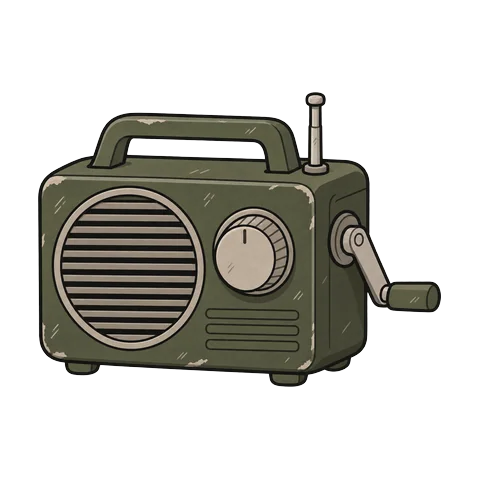
Wind-up emergency radio
(Ad) See on Amazon
The government's Be Ready checklist asks for an FM radio, battery or wind-up, because updates may be given on air when phones and broadband are down. The UK's Chief Medical Officers go further for the unlikely event of a national power outage: emergency messages would be limited to radio, on BBC Radio 2 and Radio 4, which they call "the most power resilient form of communication". You would need a battery-powered, wind-up or car radio to hear them.
Ways of powering it
A wind-up radio has a hand crank that charges it, and most add another route, such as a solar panel or USB cable. Look for more than one, because each has a weak spot.
- Hand crank: needs only your arm, but how long a minute of winding lasts varies with the radio and how you use it. Any figure on the box is the maker's, so time it yourself.
- Solar panel: needs daylight, which a winter power cut may not offer. Treat it as a top-up.
- USB: the easy way to start full, while the mains still works.
- Ordinary batteries: Be Ready says to keep spares with your radio, so a set that takes them can keep going after your arm gives up.
FM, DAB and the other bands
Start with FM. Be Ready's checklist names it, and its power cut advice is to try FM and digital modes to find stations still broadcasting. A 2021 review concluded there should be no mandated FM switch-off until at least 2030. A new government review is asking whether to move away from FM in the 2030s. Its report was due in autumn 2026, so check for news.
DAB is harder. Which? says most of the DAB radios it has tested run from mains or batteries, so a wind-up with DAB may take some finding. If you do buy one, check for DAB+, because a set without it can only receive services broadcast in plain DAB. The Digital Radio Tick Mark means a radio has been approved to receive FM, DAB and DAB+.
Don't buy for long wave or medium wave. BBC Radio 4 left long wave on 27 June 2026, so any advice to tune there is out of date, and the last BBC local radio services on medium wave close by the end of November 2026. If a listing mentions NOAA or a weather band, that is a US network, which is useful if your power cut is in Ohio.
Before you need it
- Write your stations' frequencies on paper, as Be Ready advises. Its household plan gives BBC Radio 2 on 88-91 FM as an example.
- Try the radio where you would actually sit. The BBC says basement flats and steel-framed or reinforced concrete buildings can affect DAB coverage.
- Charge it, then check it whenever you check your kit. Be Ready suggests a reminder every six months.
What it can't do
A radio only listens, so it can't call for help. If you can't reach the emergency services, Be Ready says to try both a mobile and a landline. If that fails and it is safe, go to emergency responders directly, or to the nearest police station, fire station, ambulance station or hospital.
Nor can it promise news about your street: Be Ready says only that there might be updates. In the UK, report a cut on your local network operator's website, or call 105 in England, Scotland and Wales, or 03457 643643 in Northern Ireland. Write those down as well.
Some wind-up radios can top up a phone, and many double as torches. Treat those as extras. Be Ready lists a torch and a power bank as separate items.
A car radio works too, while its battery lasts, but Be Ready says staying inside may be safer in severe weather.
The short version
- Buy for FM first. DAB+ is a bonus if you can find it.
- Look for more than one power source, and keep spare batteries if it takes them.
- Write your frequencies on paper.
- Try it now, and again at every kit check.
- It only listens: you still need a torch, a charged power bank and a way to call for help.
This is general information. Official instructions for your area always come first.
Free: the 3-day kit checklist
Sign up and get our printable checklist of what to keep at home for three days. Then about one short email a week with a small job to do. It takes minutes, and Harry won't do it.
Get the free checklist and about one email a week with safety tips and kit ideas. Unsubscribe any time. Privacy notice.
What we read
- GOV.UK, Be Ready: Be ready for emergencies
- GOV.UK, Be Ready: Power cuts
- GOV.UK, Be Ready: Phone and broadband outages
- GOV.UK, Be Ready: Household emergency plan
- GOV.UK: UK Chief Medical Officers' advice during a national power outage
- GOV.UK: Digital Radio and Audio Review
- GOV.UK: Ministers kick off review to safeguard radio's future
- Digital Radio UK: When is digital switchover happening?
- Digital Radio UK: Digital Radio Tick Mark
- BBC: Help receiving TV and radio
- BBC: Local Radio medium wave transmission changes
- WorldDAB, from the BBC: Radio 4 broadcasts on long wave end on 27 June 2026
- Which?: What to pack in an emergency kit
- NOAA: NOAA Weather Radio