Ad Links marked (Ad) are affiliate links. As an Amazon Associate I earn from qualifying purchases.
Products here are on topic, but we haven't tested them. Drawings are ours, not photos of the exact product.
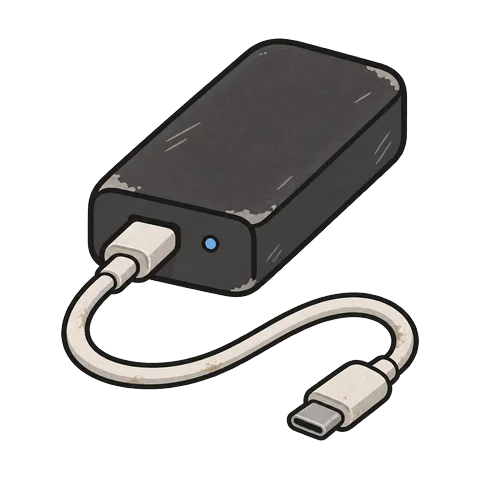
20,000 mAh power bank
(Ad) See on Amazon
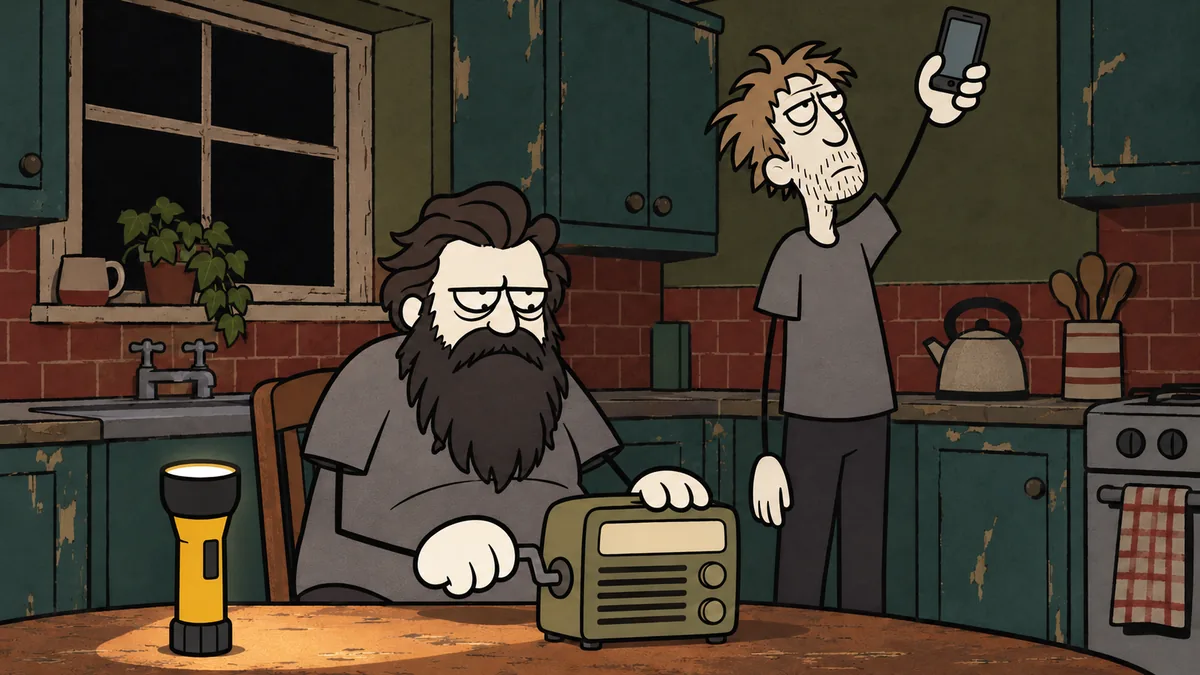
The government's Be Ready checklist lists a charged power bank, to charge phones or compatible medical devices. It can't fix the network, though: Be Ready warns that your mobile might stop working if your local mast is in the affected area. So keep important numbers on paper as well.
What capacity means
Capacity is measured in mAh, which Which? compares to the size of a fuel tank. Electrical Safety First says it decides how many times you can recharge a device, while output power decides how quickly. Which? uses a phone with a 4,000mAh battery, roughly average for modern smartphones, and gives these bands:
- Up to 7,500mAh: usually one charge.
- 7,500 to 14,999mAh: usually two.
- More than 15,000mAh: usually four or more, and up to five for the largest it has tested.
Don't simply divide one number by the other. Which? finds that banks with the same claimed capacity supply different amounts of energy, some losing a lot as heat, and some small ones could not manage one full charge.
How much a phone needs
Be Ready plans for three days. One phone charged once a day is three full charges, more than a medium bank usually gives. Two phones is six, more than a large one usually gives. You can stretch that: Be Ready says to use devices sparingly and warns that a phone's torch drains its battery, so keep a real torch.
Electrical Safety First says a power bank is for phones and other USB-powered mobile devices. Check medical equipment with its supplier. Which? says a bank with lower wattage than a laptop needs can strain the laptop's battery, and that running appliances takes a far larger power station.
Keeping it ready
Recharging takes time: Which? talks of waiting six hours for a charge, so fill it before the forecast turns. On storage, sources pull different ways. Be Ready lists the bank as charged and suggests checking your kit every six months. Makers, who are not official sources, ask for more: Anker says to recharge every three months and store at about 50%, while UGREEN says every two to three months at 50% to 80%. Both warn that leaving one flat can harm it. Your manual decides. Whatever it says, set a reminder and recharge after every cut. A bank you last charged in 2023 is a paperweight.
Safety and storage
Most power banks use lithium-ion batteries, and Fire Kills says a lithium-ion battery fire can develop within seconds, often without warning.
Buying: Electrical Safety First says to use a reputable retailer rather than a third-party seller online, and to register the bank so you hear about recalls. In 2019 Which? found six of eleven unknown-brand banks bought from online marketplaces failed its tests. A familiar name is no guarantee either: late in 2025 the Office for Product Safety and Standards published recalls of certain Belkin and Xiaomi models because their lithium-ion batteries can overheat. Check GOV.UK's recall list.
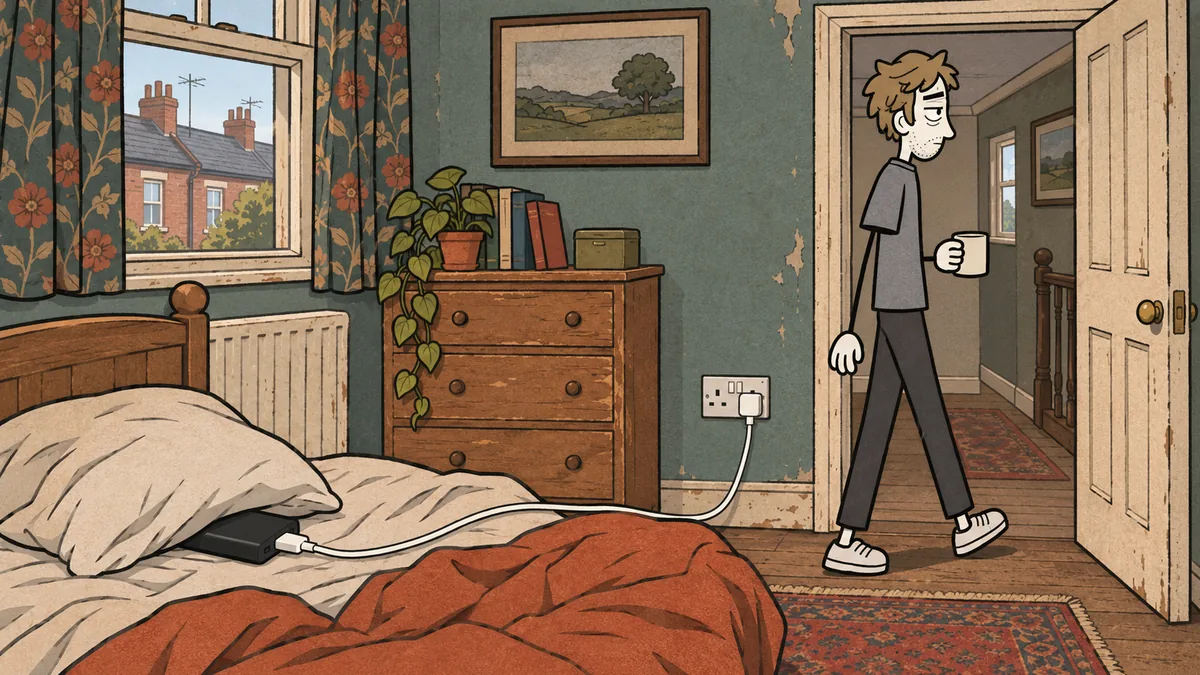
Charging: Electrical Safety First says to unplug it afterwards, keep it uncovered and ventilated, and not charge it overnight or while you are out. Fire Kills says not to charge e-bike batteries in bedrooms or where escape routes can be blocked, which is sensible here too.
Storing: keep it away from heat, direct sunlight and water, out of parked cars, and away from coins and keys, which can short-circuit it.
Stopping: if it is too hot to handle, or you notice odd smells, sparks, smoke, swelling, cracks or damage, unplug it and contact the retailer or maker. Don't try to repair it. If there is a fire: get out, stay out, call the fire service.
Disposing: never use the general waste or normal recycling, where a crushed battery can start a fire. Take it to be recycled, and check first that your local site accepts this type.
The short version
- Think in phone charges, not mAh.
- Plan for three days and every phone in the house.
- Buy from a reputable retailer, then register it.
- Charge it while you are awake and at home, uncovered and off your escape route.
- Check it every few months, as your manual advises.
- It keeps a phone alive, not the mast.
This is general information. Official instructions for your area always come first.
Free: the 3-day kit checklist
Sign up and get our printable checklist of what to keep at home for three days. Then about one short email a week with a small job to do. It takes minutes, and Harry won't do it.
Get the free checklist and about one email a week with safety tips and kit ideas. Unsubscribe any time. Privacy notice.
What we read
- GOV.UK, Be Ready: Be ready for emergencies
- GOV.UK, Be Ready: Power cuts
- GOV.UK, Be Ready: Phone and broadband outages
- Electrical Safety First: Power banks and portable chargers
- Which?: Power banks and portable chargers
- Which?: What capacity and cost mean for a power bank
- Which?: What to pack in an emergency kit
- Which?: Unsafe chargers and power banks on online marketplaces (2019)
- Fire Kills, GOV.UK: E-bikes and e-scooters
- Fire Kills, GOV.UK: Detection
- Office for Product Safety and Standards: Product safety alerts, reports and recalls
- Office for Product Safety and Standards: Belkin power banks recall
- Office for Product Safety and Standards: Xiaomi power bank recall
- Anker: How long does a power bank hold a charge?
- UGREEN: Do power banks drain when unused?