Ad Links marked (Ad) are affiliate links. As an Amazon Associate I earn from qualifying purchases.
Products here are on topic, but we haven't tested them. Drawings are ours, not photos of the exact product.
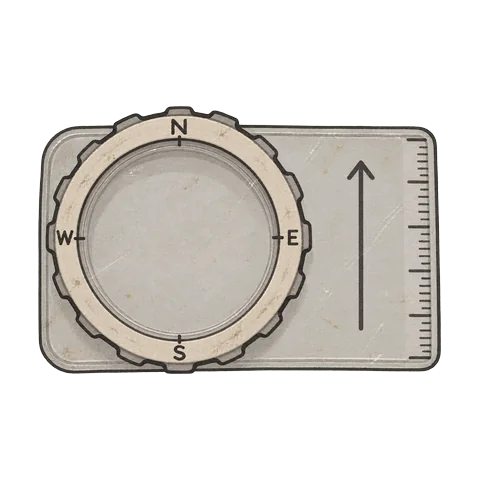
Map compass
(Ad) See on Amazon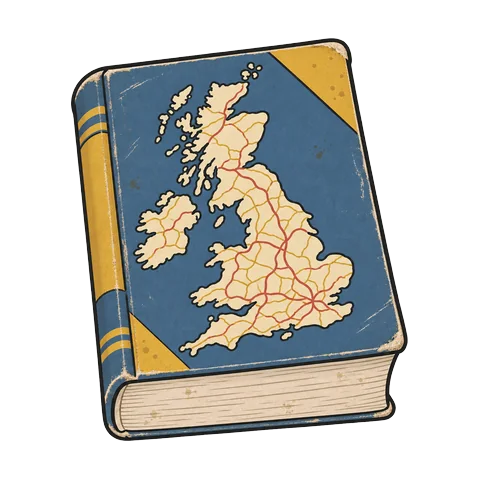
Road atlas of Britain
(Ad) See on Amazon
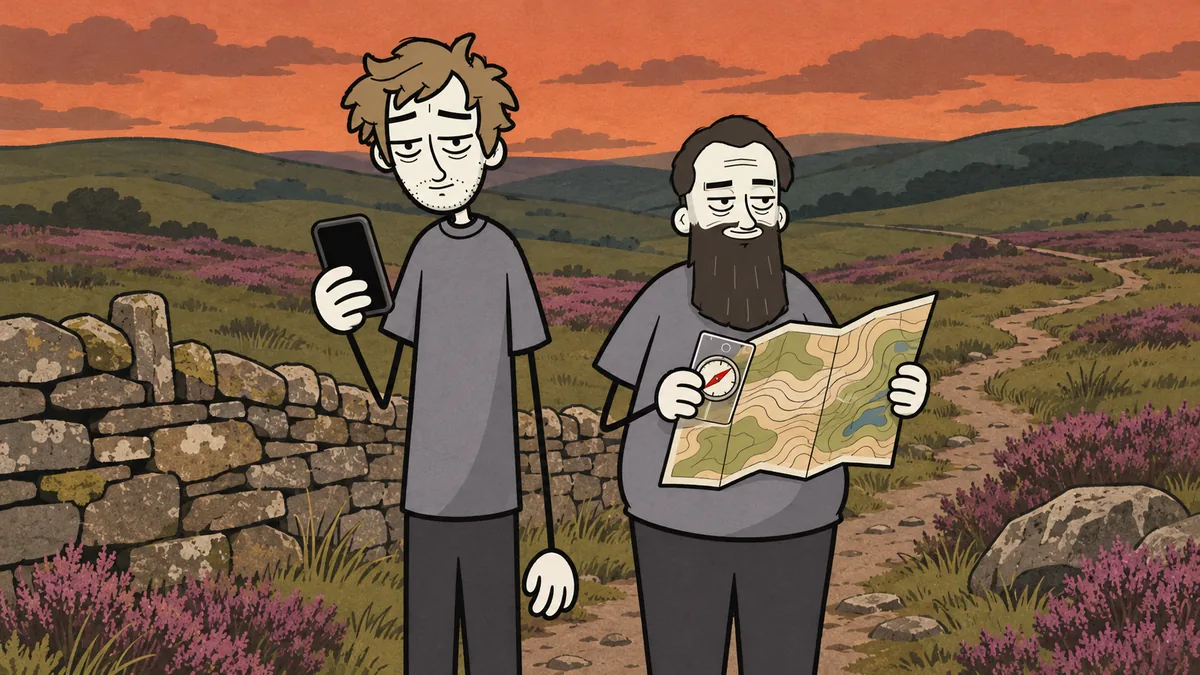
Most of us navigate with a phone now, and most of the time that works well. The trouble starts when it doesn't: a flat battery, no signal, or an app that can't place you. Mountain rescue teams in the UK see this often, and their advice is to always carry a back-up that does not need power.
Why the phone isn't enough
In an interview with Ordnance Survey, a mountain rescue team explained that walkers today are more likely to rely on electronic devices than buy a paper map, and the problem is that they have no analogue back-up when the phone battery goes. Their advice: keep your battery charged, don't use the phone more than you need to, carry a spare device if you can, and use proper maps of the area. A paper one is the back-up that does not depend on a battery.
A paper map never runs out of charge. Paired with a simple baseplate compass, it lets you work out where you are and which way to go, whatever your phone is doing.
Walking "straight" is harder than it sounds
Without landmarks, many people assume they can just keep walking in a straight line. Research published in Current Biology in 2009 suggests otherwise: when people walked without the sun or other clear landmarks to guide them, they often ended up walking in circles without realising it. That is why it pays to check your direction with a map and compass rather than trust your sense of a straight line.
Setting your map with a compass
The most useful first skill is setting, or orienting, the map:
- Hold the compass flat and let the needle settle. The red end points north.
- Turn the map until its north, usually the top edge, points the same way as the red end of the needle.
- Now the roads, rivers and hills on the map line up with what you can see around you.
Once the map is set, you can match features on the ground with features on the paper and work out where you are. Practising this on a familiar walk, before you need it, is the best way to learn.
Using the sun as a rough guide
With no compass, the sun can give you a rough direction. In the northern hemisphere, it sits roughly to the south around the middle of the day. There is also a traditional trick with an analogue watch: hold it flat, point the hour hand at the sun, and south lies roughly halfway between the hour hand and the twelve o'clock mark. Treat both as rough estimates rather than precise bearings. The exact position of the sun changes with the season, and clock time is not the same as solar time, especially when the clocks go forward in summer.
A small kit that works without power
- A paper map of the area you are in, or a road atlas for longer journeys.
- A baseplate compass.
- A charged phone, used sparingly, as a back-up rather than your only guide.
This is general information. Official instructions for your area always come first.
One small job a week
A short email with what's new here and, now and then, one thing to sort out before it goes wrong. It takes minutes, and Harry won't do it.
About one email a week with safety tips and kit ideas. Unsubscribe any time. Privacy notice.